Documentary and original soundtrack by j-hope of BTS, available on Prime and TVING.
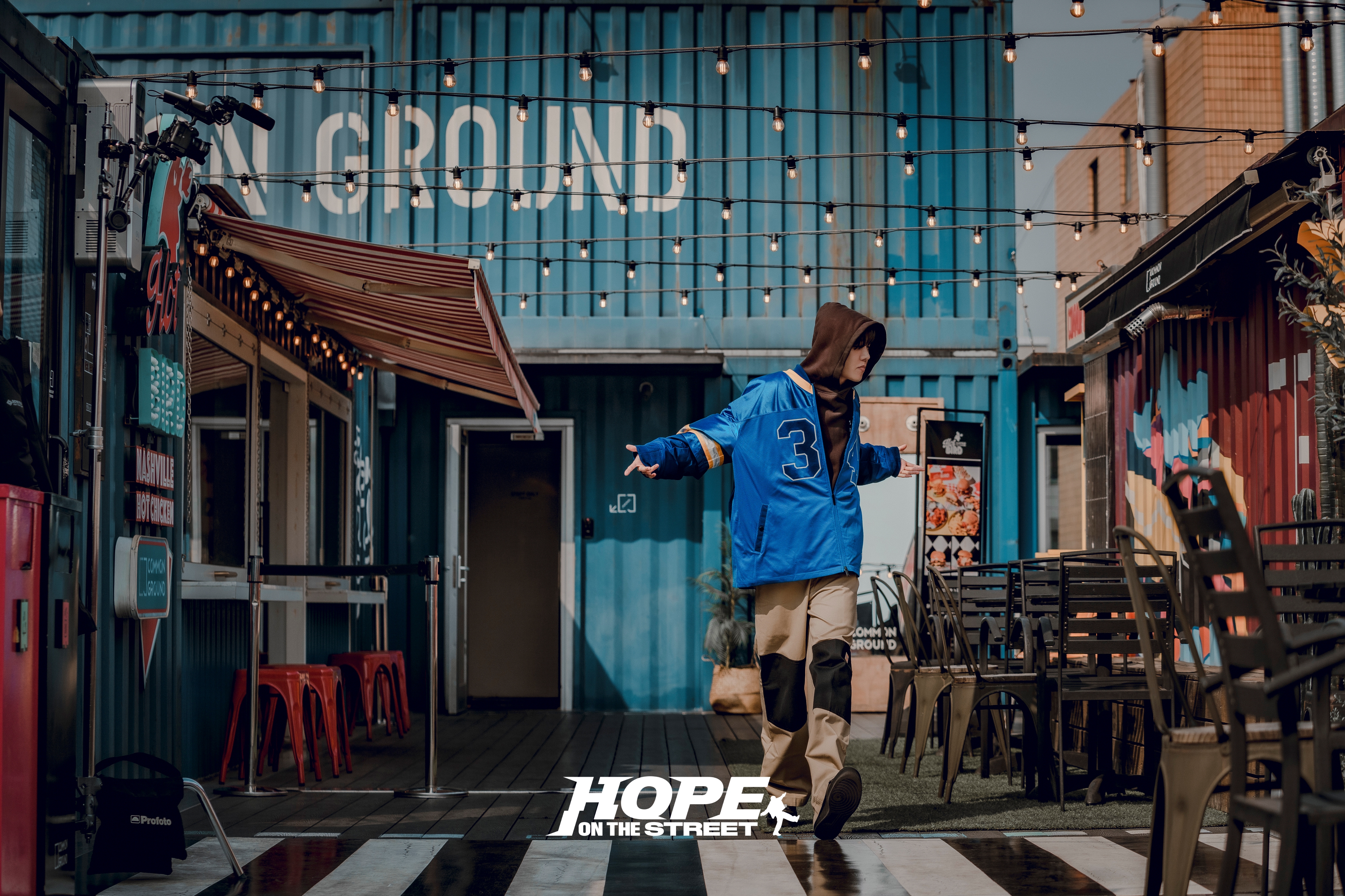
j-hope’s new documentary Hope on the Street and its accompanying original soundtrack, Hope on the Street Vol. 1, mark a new high for the rapper, dancer, and member of the South Korean band BTS. Directed by Park Jun Soo, the six-part series, released on March 27, is an aesthetic and narrative triumph.
Created by j-hope as a final project before enlisting in the military to fulfill his mandatory service, Hope on the Street follows his quest to reconnect with his dancing roots after a decade of building a musical career as a member of BTS. To do this, j-hope calls on one of his first teachers, Boogaloo Kin (Kim Haknam), a South Korean dance champion, to guide him and help him connect with some of the best street dancers and teachers around the world.
In their journey, j-hope and Boogaloo Kin explore a style of street dance in five different cities: Popping in Osaka, locking in Seoul, house in Paris, hip hop in New York, and finally, a return to Neuron, the dance crew he studied with in his teens in his native city, Gwangju. Throughout, Boogaloo Kin accompanies j-hope as a friend, dance teacher and life mentor.
From the opening scenes, the documentary establishes a striking visual style that feels as free and inspired as the choreographies or dance practices that are the base of the narrative. Special effects, abstract animation, alternating lo-fi and HD footage, surprising and expressive editing, and an impeccable and understated soundtrack all result in a documentary that deals with street dance as its subject matter and reflects its essence through its formal construction. Still, the through line of the documentary is j-hope’s love for dance, his humbleness, and his desire to learn and connect with his teachers and other dancers. The formal beauty and dynamism of the images and sounds only enhance the humanity of the project.

Hope on the Street is j-hope’s second documentary after J-Hope IN THE BOX (2023), which followed the artist’s preparation for his solo show at Lollapalooza in July 2022. While the subject of both documentaries is the same (j-hope), the two are a study in contrast: the nearly unbearable stress we see him go through as he prepares for his set at Lollapalooza is almost completely gone in Hope on the Street. Still, the documentary doesn’t shy away from showing j-hope’s moments of vulnerability and self-doubt as he embarks on this project; the difference is that this time, we see him confront his insecurities with more lightness and humour.
One reason for this could be that Hope on the Street does not center j-hope as a musician or a member of BTS but as a dancer reconnecting with his roots. As he explains in the first episode, dance was his entry into what later became a music career as a rapper, writer and dance leader within BTS. The band’s genre-bending hybrid between hip hop crew and idol group meant that j-hope developed numerous other skills besides dancing. What was once his primary discipline, dance, became one among many other things he excelled at, but not the main focus. The documentary shows his process of reacquainting himself with his first passion. Hope on the Street’s perspective is also that of j-hope as a student, and the spotlight is as much on his story as the story of the dance style and the professional dancers he joins in each city. These dancers appear alongside j-hope as they teach him a new choreography, share their wisdom, and tell their own stories.
Candid conversations between j-hope and Boogaloo Kin or the other mentors intersect with exhilarating dancing footage, which, rightfully, are some of the most unforgettable moments of the series. Some of my favourites are a freestyle dance on top of iconic Parisian stairs, the enthralling introduction of Boogaloo Kin on the first episode, and a dance cypher between j-hope, Boogaloo Kin, and Lock Woong, a Korean locking legend, in a back alley late at night in Seoul.

Some of the most moving scenes are those where j-hope’s admiration for the street dance greats he gets to work with is evident, such as when he learns from Henry “Link,” one of the preeminent figures in freestyle hip hop or Yungson Hawks, a house dance master. As he explains in the interviews that frame the documentary, his main goal for the project was to learn and, in the process, address some of his preoccupations with the future: “I was just curious what my future would be like and whether I would still like the things I do in the future,” he explains in the second episode, entitled “i wonder.” “i wonder” is also one of the original songs he wrote for the soundtrack, which is as remarkable as the documentary.
In addition to “i wonder” (featuring his bandmate Jung Kook), j-hope wrote and recorded three other new tracks and remixed two previously released songs to accompany the documentary. This attention to detail and understanding of the musical genres associated with each dance style match the spectacular visuals of the series. “Neuron,” the album’s title track, which pays homage to the Neuron dance crew, is an anthem to celebrate what is beautiful right now and look toward the future with beliefs, hopes and values reinforced. It’s a reaffirmation, and there is an ease that comes with that.

We can hear this ease in “i wonder”’s danceable and dynamic groove, but one that’s chill enough to just keep you effortlessly moving. “This love right now/It’s all we got, all we need/We’re happy right now/So why don’t we ride this feeling” j-hope and Jung Kook sing in sweet harmony. “lock/unlock”, featuring a signature riff from Nile Rodgers, the legendary guitarist and producer from Chic, is pure classic funk but again, just cool enough to keep you dancing for a long time. The album standout for me is “i don’t know” featuring HUH YUNJIN (Le Sserafim) with a delicious house beat and relaxed, elegant vibes. Other standout moments are Gaeko and Yoonmirae’s features on “Neuron” with both their verses further grounding the song and highlighting j-hope’s return to his roots.
Though concerned with serious questions about life and artistic purpose, the documentary is first and foremost a showcase for street dance and its culture. The synergy between j-hope and Boogaloo Kin is also a pleasure to witness – a mixture of humour, mutual admiration and respect. Even more edifying are the interactions among all the dancers, as they seem to always be guided by a pure and selfless love of dance. Most memorable of all: j-hope’s warm, easy joy and that impossibly bright smile illuminating every episode.

 The Things We Love