
On the stage, as part of BTS, j-hope has a spellbinding energy. In “Hope On The Stage,” his first solo world tour across the US, Mexico, and multiple stops across Asia, this energy feels like it has been magnified by several degrees. The tour marks his return to the stage after completing his mandatory military service in South Korea, an extremely significant moment of reunion, renewal and growth for any artist.
j-hope launched his “Hope On The Stage” tour in Seoul at the end of February with three shows that were live-streamed for fans around the world. The concert, which runs just over two hours and fifteen minutes, is divided into five sections: Ambition, Dream, Expectations, Fantasy, and Wish.
Each section is built around a different set design, outfit and selected tracks from j-hope’s and BTS’s discography. The setlist, which runs through 27 tracks, is perfectly paced and balanced, and the show is like a masterclass in restraint, flow, and direction.
The introduction to the first set, “Ambition,” is unforgettable. After watching the first VCR (short narrative videos that frame the performance) the focus becomes the stage, a red square made up of individual boxes which seem to breathe under a mysterious veil. At times, depending on your view of the stage, the boxes appear to replicate a checkered pattern, one of the main visuals of his first solo album, Jack in the Box.
The show starts with “Music Box: Reflection,” a song from Jack in the Box that works as a mid-album interlude. In “Hope On The Stage,” the tempo of “Music Box: Reflection” has been significantly slowed down to match the movement of the boxes. The effect is ominous and sinister; we intuitively understand that we are in immediate danger, in this case, the danger inherent in the confrontation of the self that j-hope illustrated in Jack in the Box.
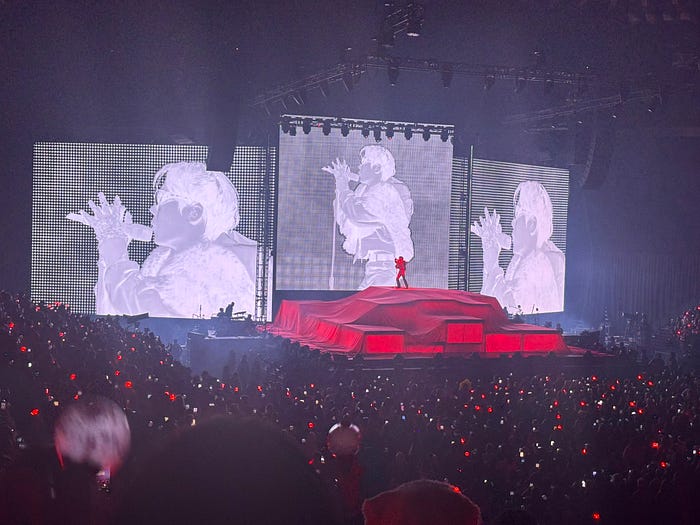
When j-hope emerges fully dressed in red to match the stage and the images playing on the screens, he is the embodiment of controlled fire and power — cool, measured and deliberate, an intimidating aura emanating from his striking figure.
He starts the show officially with “What if,” a song where he contemplates what his life would look like if he wasn’t j-hope of BTS but simply Jung Hoseok — could he have achieved what he has if he had not become j-hope? The powerful anthemic “Pandora’s Box,” second on the setlist, tells the myth of how he came to represent “hope” for his band and fans, ARMY. It’s a back-to-back display of the explosive tone of his first album, an incredible mix of boom bap, grunge, and R&B.
As played live on this tour, the songs emphasize the album’s rock elements through prominent guitars and drums, bringing the intensity of the performance to a hypnotic level. This continues with “Arson,” which starts with what sounds like a fire alarm — an effect now amplified in the live version. The song contains a repetitive refrain, a low, drone “burn, burn, burn.” When the audience joins j-hope — thousands of voices singing “burn” in unison — it feels like an incantation, the invocation of a collective ritual of fire and rebirth.
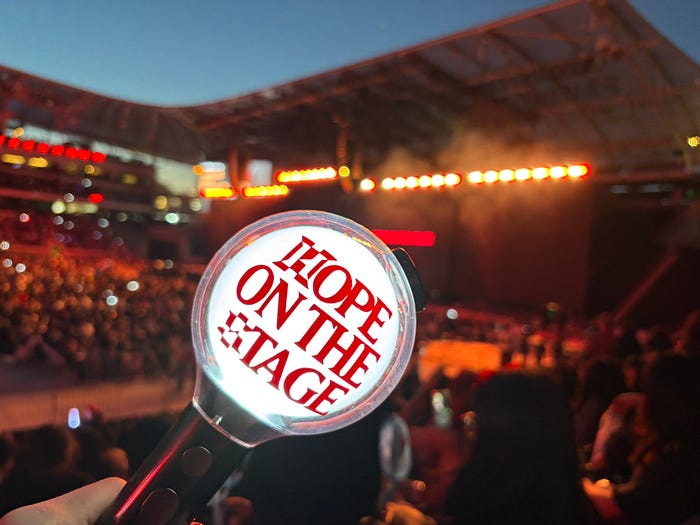
The set production is outstanding, and it creates a sense of being completely immersed in the story j-hope is telling; this remains true throughout. There is incredible attention to detail, such as at the end of “Arson,” when ARMY’s light sticks — automatically coordinated to complement the show — go from red to a low yellow, suggesting the remaining embers amid the ashes after a fire.
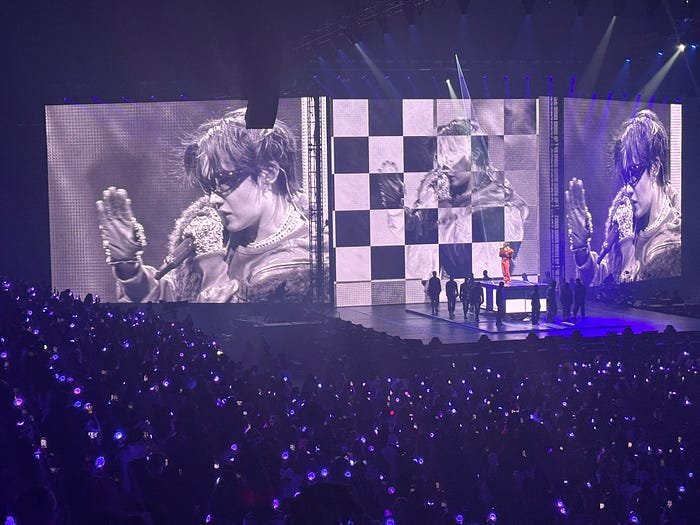
Despite the incendiary feel of this opening section of the show, this theatrical performance of the songs from Jack in the Box is a manifestation of j-hope at his most cerebral, his story of ambition exquisitely executed through the restrained sophistication of his stage. But j-hope was a street dancer before he became a rapper and songwriter as part of BTS, and he is not only a uniquely intellectual artist but one whose first language is dance. Starting in the second set and continuing for the rest of the show, dance is at the core of nearly every performance, showing how dance is in j-hope’s artistic and personal DNA.
The ”Dream” section that follows begins with j-hope freestyling to the intro of “on the street,” the single he released before starting his mandatory enlistment and which features revered rapper J. Cole, a musical inspiration and hero of j-hope. Watching this performance in person made me understand that to see j-hope dance live is a privilege, a gift to treasure among the special memories of your life. If dance is movement and expression, history and celebration, for j-hope it is also primordially, connection.
When you see j-hope dance, it feels as if every move he makes is meant to engage in a conversation with his audience who then hangs on every word he raps or sings. Like the best conversations, the one he establishes is sincere, deep, and revealing — the kind that brings you closer and forges a stronger bond with the other person.
The “Dream” set is mainly dedicated to his second album, Hope on the Street Vol. 1, a celebration of street dance and the musical genres that inspired them. Colourful and moving, this section also highlights j-hope’s supporting dancers, a mixture of backup and street dancers who bring beautiful authenticity to the stage. Singing and dancing against the backdrop of an old-style boombox projected on the screens, this is the moment j-hope pays homage to his beginnings as a street dancer. Moving effortlessly between “lock unlock,” “i don’t know,” and “i wonder,” a song featuring his bandmate Jung Kook (who was still serving in the military during j-hope’s tour) we start to understand the revolutionary power of music and dance as a unifier of people.
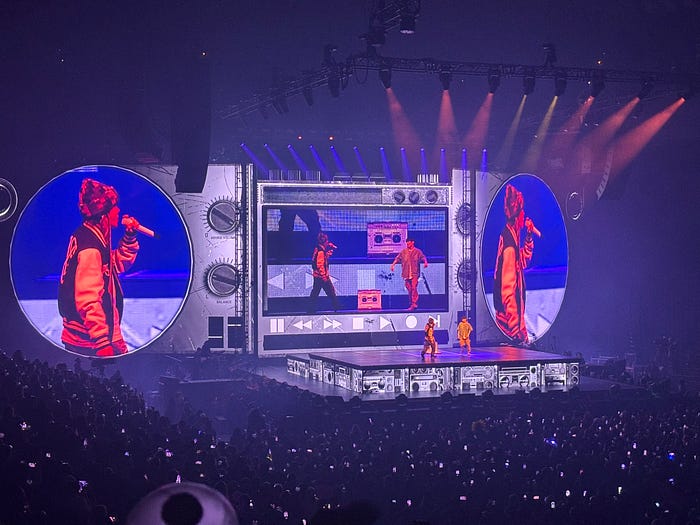
Street dance was born on the streets out of Black and Latin American culture in the US, and it’s by nature social and inclusive — a space where the ground is at the same level for everyone. This ethos permeates this section of the show and beyond, such as the moment when j-hope descends the stage to walk alongside the barricades singing “1 VERSE,” a very early unreleased hip hop track only available on SoundCloud and “= (Equal Sign),” a song from Jack in the Box where he expresses his wish for real equality of race, belief and culture.
To me, the message of “= (Equal Sign)” is fundamental to how j-hope sees the world and the way he expects others to be — he not only says it in his songs, he embodies it and exemplifies it in every interaction he has. In the show, during the section entitled “Wish,” he walks slowly in front of ARMY, touching and shaking hands until he finds a person to whom he connects and then, holding their hands, sings the intro of the song in Korean: “We prepare to see each other, and meet each other’s eyes. No one is above anyone else, and no one is below anyone else. Let’s roll.”
This is a moving moment of authentic connection, significant beyond the performance and the tour. It sends a larger message of unity between BTS and ARMY and the wish to reunite with fans after a year and a half away while fulfilling his military service. These moments have become one of the central memories of this tour, an example of the expressed appreciation BTS has for their fans, ARMY, who they see and treat as individuals, and the active mutual upholding of each other’s humanity which is at the heart of BTS and ARMY’s relationship.
When j-hope begins “Trivia: Just Dance,” a song from BTS’s album Love Yourself 結 ‘Answer’ the show reaches a peak of exhilaration that’s hard to describe to non-fans. The set titled “Expectation,” where he performs several BTS tracks interspersed and in dialogue with songs from his solo albums has the same effect. There are many highlights.
One is the moment j-hope launches into “Baepsae (Silver Spoon),” a 2015 BTS song that serves a scathing social critique of South Korea’s class system alongside an iconic choreography that includes in-your-face hip thrusts. Its significance is deep, a reminder of the great feat BTS has achieved in becoming a globally beloved artist who has spread love and interest in Korean culture and language well beyond their borders.
Every element of this concert has been carefully curated to support the narrative j-hope has built from his first mixtape, Hope World (2018) through his two albums Jack in the Box (2022) and Hope on the Street Vol. 1 (2024) and his newly released singles, “Sweet Dreams (feat. Miguel)” and “Mona Lisa” in which he is embracing his more mature and sensual side. There is coherence and a sense of vision and purpose throughout.
BTS concerts are high-participation events, and j-hope’s show follows the same spirit. This is a concert where the audience sang along to every song in every language (in this case Korean, English and Spanish), engaged in the now epic “Mic Drop” fan chant listing every member of BTS — a moment that brought crackling electricity to the air, and had a section where ARMY fan signs were shown and highlighted on the stage screens to emotional cheers.
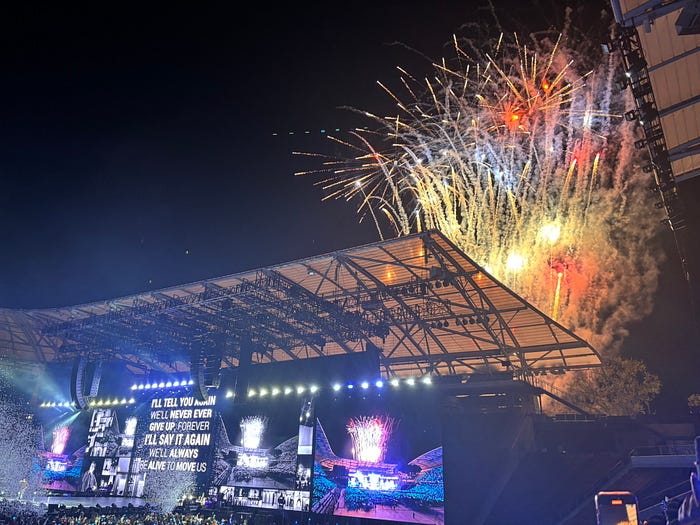
Accompanied by an amazing live band, powerful song arrangements, an extremely talented dance crew, immersive storytelling through VCRs and set designs, and even fireworks at the end of the stadium show in LA, “Hope On The Stage” is a large-scale spectacle and celebration. All of this would be meaningless without the person at the core of it all, j-hope, who is gifted with a rare energy and magnetism, qualities that to me remain a mystery to decipher.
As ARMY counts the days until BTS’s awaited reunion in June 2025, the moment when all seven members will have completed their military service, “Hope On The Stage” felt like a love offering by one of its members, but also a righting: there’s no place that j-hope belongs more than to the stage.
This review was written after attending three shows of the “Hope On The Stage” tour in Oakland, California, on March 31 and April 1, and in Los Angeles, California, on April 4, 2025. It was originally published on the blog, “BTS, With Sincerity.”
Lyrics translations by Doolsetbangtan.

 The Things We Love