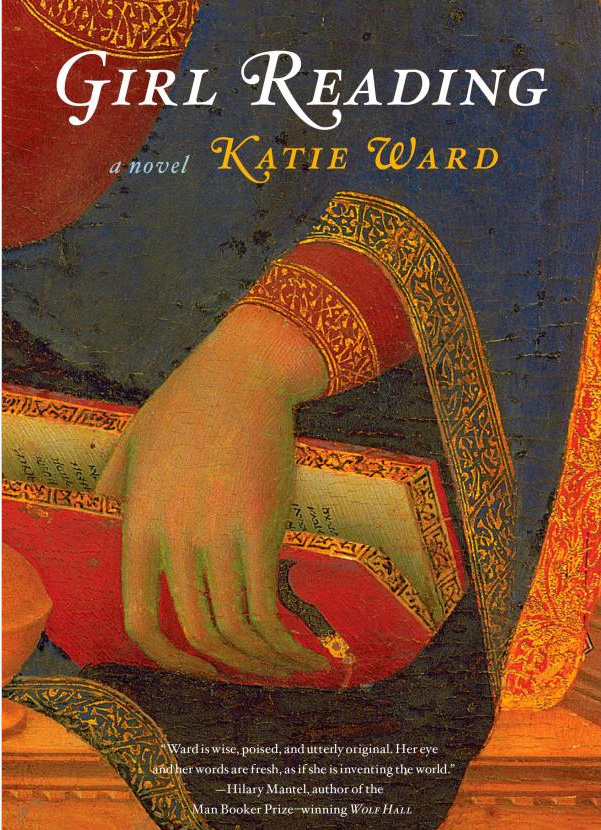
One of the privileges of youth is time. Yes, we are all handed the same amount every day; it’s just that, as we get older (and especially after having children), we fill ourselves with so many responsibilities that some things start to get thrown out of the window (in my case: exercising, listening to music, reading anything longer than gossip blogs and Twitter feeds, sanity, at times). It’s not completely negative; having “less time” has forced me to become more decisive and more practical. I’m still hugely indecisive and unpractical, but I’m a little bit better. So for the last couple of years, when I go to the library, not having had any time to read book recommendations, I’ve been relying on the library staff’s last-release suggestions. I have found some very good books this way and also, like most people, by totally judging books by their covers: my weakness is books with paintings on them. One of these was Girl Reading, by Katie Ward.
More than a novel, this book reads like a collection of short stories very delicately tied together by images that appear in each of them. The stories start in the 14th century and move through history until we reach the late 21st century. The beautiful cover of the edition I read shows a detail from Annunciation by Simone Martini (1333). “Annunciation” is also the title of the first chapter. The first story takes place in 1333. A young woman, an orphan living in a convent, is chosen to sit for a master painter. She doesn’t understand until much later that she will be the model for the virgin in the painting, the same one that we see on the cover. Ward plays with the themes of the painting (the annunciation, immaculate conception), and they become part of the story itself in a very subtle, but smart way. And so it is for each chapter, where she imagines the story behind the images, the circumstances that may have led to its creation.
Ward writes with a beautiful lightness of touch and seems not only able to capture the time period of each story but inhabit the images and paintings that we associate with it.
In “Angelica Kauffman: Portrait of a Lady, 1775”, she writes about a bereaved lover consumed by the sadness and loneliness of death. She is a countess, though she has lived away from her husband for quite some time. Her beautiful lover has recently died. She summons the famous painter Angelica Kauffman to complete the portrait she had started of her lover, the subject of Kauffman’s Portrait of a Lady. Ward is wonderful in that she gets the time period, the history, the manners, in just a few pages. The poor countess falls from society when one of her many creditors accuses her and her lover, Frances, of being lesbians. Kauffman has been a friend to the countess and remembers Frances when she was alive. The days go by while she tries to finish the painting from memory and as the countess slowly starts to heal. It’s a very moving story about love and loss and perhaps also about the healing power of art.
The most thought-provoking story is the last one. It takes place in 2060. By this time, governments had to lock and protect most Western art due to some sort of international conflict where art was mostly kept in private hands. So most people’s experience of art, books, sculpture–everything, is virtual. Life is experienced in large part through a highly enhanced virtual reality called “Mesh.” Children’s lessons at school are in mesh, games are in mesh and pets, of course, are virtual. It is not only about a world where you can live away from your family but still be present through your highly realistic avatar, but also about a world where material objects and the pleasures of touching, feeling and seeing in the real world are becoming rarer and rarer. This doesn’t sound unfamiliar: we already seem to have access to everything we can imagine on the Internet, but at least we can still experience some real art in the real world if we choose to.
The story touches on the theme of identities as well, both our virtual identities and our real identities. Sibil, a new scientific creation, is at the heart of the story. She is not a robot, but she is the definition of artificial intelligence: a complex, extremely advanced algorithm. She organizes and classifies information in a way that allows people to experience works of art in a highly interactive way. Through Sibil, a work of art is enriched by all the traces of information that could possibly be attached to it, and this shapes each viewer’s experience. I already feel overwhelmed by the vast amount of information we are exposed to daily, so I can’t imagine how we will manage in 2060. I guess that’s the brilliance of Sibil’s discovery. In the end, Ward finds a way to link all the images and the stories together through Sibil.
Every once in a while, when I was reading the book, I would turn to the end and look at Katie Ward’s picture and bio: she was born in 1979 and this is her first novel. It’s an admirable accomplishment. Her book is beautiful, touching and erudite. I really enjoyed it.

 The Things We Love