
After suffering through months of hype, last weekend, I finally saw 12 Years a Slave, the newest film by British director Steve McQueen. It tells the true story of Solomon Northup, a New York musician who was kidnapped and sold as a slave in 1841. Adapted from Northup’s 1853 memoir of the same name, the movie chronicles in detail the horrors Mr. Northup had to endure during his 12 years as a slave in the Deep South.
As an audience, we are familiar with the themes and visual vocabulary of stories of enslavement; just last year, Quentin Tarantino’s Django Unchained brought slavery to movie theatres in a spectacular and disturbing fashion. Many films have graphically already shown the realities of enslavement: the humiliation, the injustices, the physical labour. In 12 Years a Slave, McQueen uses all the visual tropes of this type of film. Still, through framing and editing, he manages to reveal more unimaginable horrors in acute, intimate ways.
Solomon Northup was an educated man. After he is captured, he tries to write a letter to his family to tell them what happened to him. He manages to find paper but has no pen or ink. Solomon has already suffered the loss of his identity (the captors changed his name to “Platt”), and we feel his desperation and frustration as he is reminded of how voiceless he is as well. In a way, to write is to exist, but Solomon is deprived of the one act that could make his situation real to anybody who would read his story. It’s a devastating scene.
Another wrenching one shows a dance at his owner’s house, Mr. Edwin Epps, played by the brilliant Michael Fassbender. We have already seen this man’s madness and cruelty in the way he runs his plantation. But here, the camera puts us right in the middle of the dance, the colourful dresses and cheerful couples taking all the space on the screen.
But then the camera makes a sharp turn. What we see then is a sort of subversion of a 19th-century painting; its field of vision suddenly expanded to reveal the dark secrets that have been kept beyond the frame: the musicians entertaining the guests are three enslaved men, their faces saying loudly what their instruments can’t. More than any scene of torture or punishment, it is here that we feel most deeply the shame and humiliation of Solomon and the other slaves: they are so out of place, so diminished as human beings, small and lost in the furthest corner of the room as they play the music that entertains their masters.
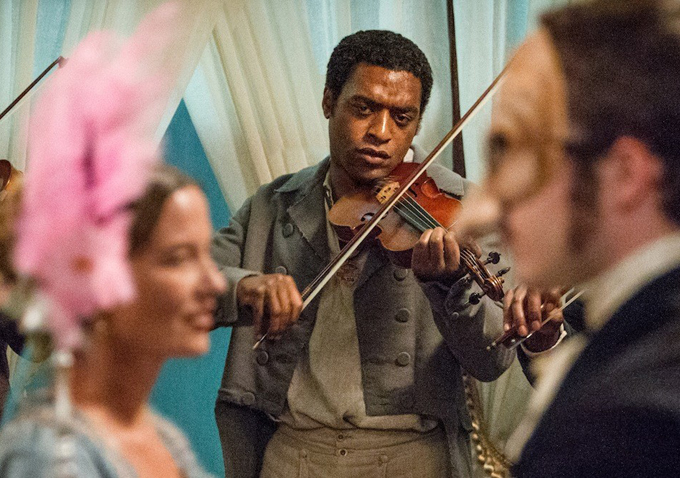
Throughout the film, McQueen finds ways of quietly revealing the horror of Solomon’s situation by placing his camera on a certain angle and leaving it there for minutes, giving us no direction other than to look, to really look at what we are being shown. He does this with sound as well, at one point forcing us to sit through an excruciatingly long scene where we see and hear a man fighting to survive after being precariously hung by the neck on a tree. You may want to turn your head around so as not to see or hear. But this story and these facts won’t go away, no matter how much we wish they had never happened.
The plight of enslaved women is also terrifyingly conveyed through the story of Patsey (Lupita Nyong’o), Epps’ favourite slave. Small and thin, she picks double the cotton daily than any male slave. Unfortunately, this wins her no favours: she is repeatedly abused by Mrs. Epps and by Epps himself, who, predictably, often visits her at night. We know of the systematic sexual abuse many women slaves endured, but what McQueen successfully evokes is Patsey’s psychological state, the profound depression and desperation that leads her to have suicidal ideations.

A critical success since it debuted at the Toronto International Film Fest last year, 12 Years a Slave has been nominated for many awards, including a Best Picture Oscar. But I don’t see it because of that; it’s really unimportant. Watch it to see Chiwetel Ejiofor’s performance as Solomon, to see his face as he realizes what consequences a conversation he just had may have on his life. See it to hear a man’s voice silenced for years raise up and join others in singing. See it not to learn about slavery nor to feel outrage or sadness at its injustice; these should be given. See it instead to feel the weight of history rest heavy on your shoulders and be reminded that you are never allowed to forget it is there.

 The Things We Love
Guauuuuu. Speechless.
Yes, you will be speechless after watching this movie….And then you’ll want to talk a lot about it. Thanks for reading!
Great posting as usual! How you bring to the point what we viewers should expect from the film: very good. It made me want to go to the cinema right away, as it usually happens with your blog postings 🙂
At the same time I have to admit that I fear watching the film, since I’m so sensitive at the moment when it comes to injustice or tragedies (let’s blame the pregnancy for that 🙂 )
Will watch it though, of course, sooner or later 😉
Thanks so much for reading! That was exactly my intention, to make people want to see the movie. It’s true that is not easy to watch at times, but the intellectual and emotional rewards that this film gives you make it all worth it. I hope you watch it soon!