Every day, women of all ages around the world look in the mirror and hate what they see. As women, our criticism of our bodies is often ruthless; our rolls, dimples, stretch marks, and cellulite are a reflection of our laziness, carelessness, and excesses. In an unending cycle, we hate, try to lose weight, become overwhelmed by the difficulty, give up and then start all over again. This hate is not innate; instead, it has been ingrained in us from an early age through a culture that measures the values of girls and women through their bodies, each pound gained and year aged, lowering that value.
The story of a body is the story of a life lived, the physical manifestation of the sum of our experiences–the sun we have enjoyed, the cold our hands have endured, the food we have eaten, and the traumas we have suffered. In her latest book Hunger: A Memoir of (My) Body, Roxane Gay writes the story of her body, confronting her past and present and all the events that led her to become a heavily overweight person for most of her adult life.
I love Roxane Gay’s voice. I loved it in her collection of essays Bad Feminist and in Difficult Women, her collection of short stories. If the tone of her writing has always seemed to me to be razor sharp and unapologetic, in Hunger I felt a new vulnerability that is humbling and one that made me extremely thankful to be a reader — thankful to have this book give voice and provide a language, to the conversation about fat bodies and their struggles for respect and acceptance. This is not an easy conversation to have: there is so much shame, loaded language, and prejudices.
But Gay is a superb writer, and she achieves this conversation with great clarity and devastating precision. Her language is careful and restrained as she explores, one by one, the fears and the traumas of her past and present and of carrying around the weight, both physical and psychological, as a fat person in North America in the 21st century. Still, and more importantly, the language is also full of compassion for herself, the girl and the teen who gained weight, and the woman who wants to lose that weight today.
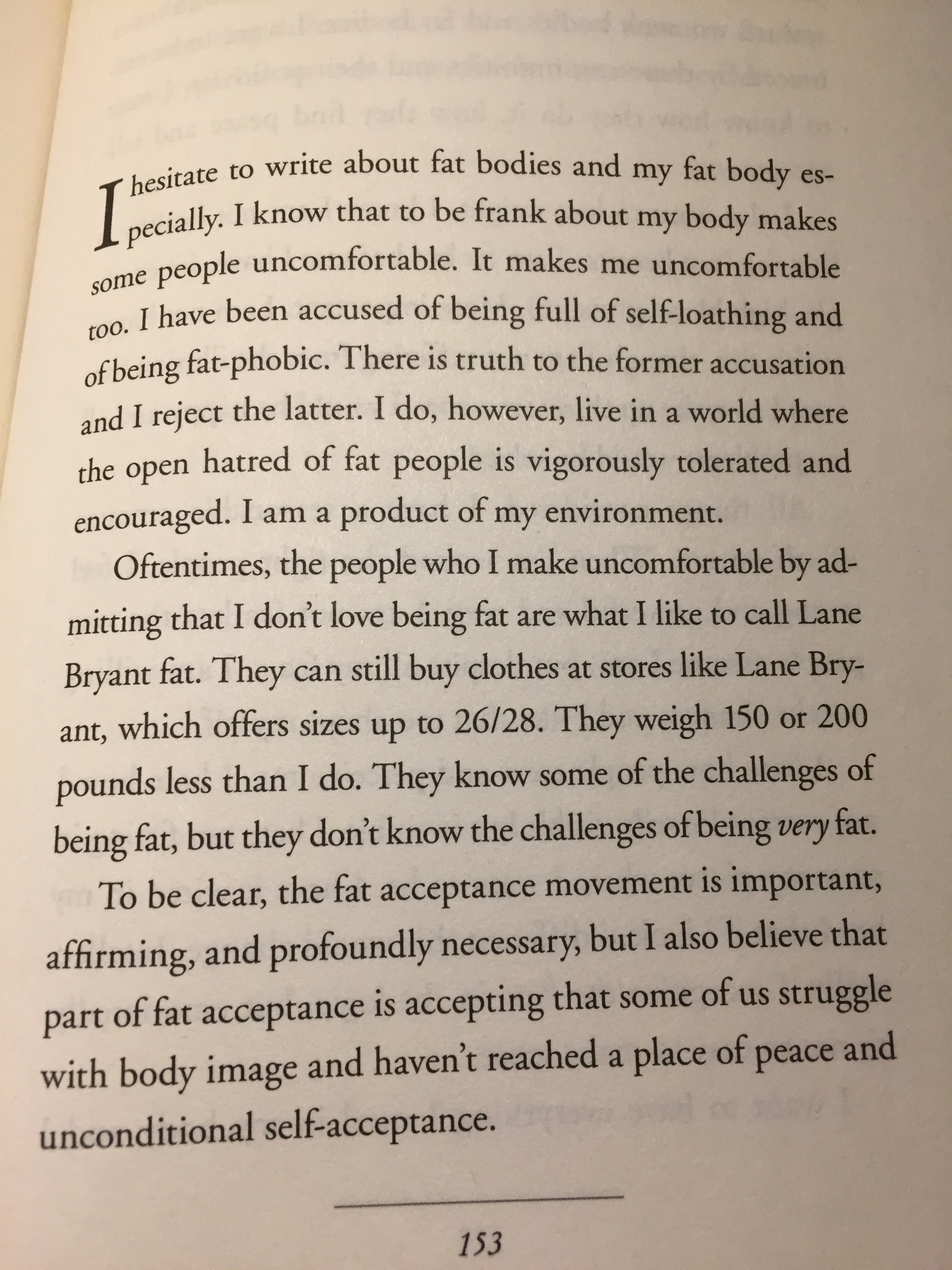
Gay’s well-known social commentary is present as well, as when she discusses the reality TV shows portraying obese individuals trying to lose weight—The Biggest Loser and others—which she watches with a mixture of curiosity, empathy, and shame. She also articulates the complexity of being supportive of the fat acceptance movement and also wanting to change her body, of being a feminist who hopes to lose weight and cares about her body in this seemingly superficial way. This is one dimension from which Gay tells her story.
The other dimension is personal and terribly painful because it involves the story of her brutal rape at 12 years old, the event to which a single direct line can still be traced to the woman and the writer she became. This is the event, kept secret for 30 years, that caused her the profound trauma that led her to punish herself with food and later on to live a self-destructive life for most of her 20s.
Anybody who has suffered from an eating disorder can relate to Gay’s memoir of her body: anorexics, bulimics and the heavily overweight share that same unsustainable and unhealthy relationship to food when what should be an essential nourishment becomes an obsession and a punishment. Food, rather than bringing nutrition and pleasure, brought Gay an escape; it was the tool she found to protect herself from the outside world and its dangers. But if the pain of her past is palpable in every page of Hunger, so is the compassion that Gay has been able to achieve through enormous hard work at accepting her past and, in turn, her body.
This is not an indulgent, tell-all book. This is a measured work of self-study and observation, a treatise on how to be kind to ourselves, of reconciling body and mind, body and soul to be whole again. It’s a book about hunger, but not just the physiological kind. It’s about the most essential hunger, that of the soul, for safety, intimacy, and connection. It is also the hunger for self-love, which, with all the noise out there telling us what we should not be, is perhaps the hardest of all loves to achieve.

 The Things We Love
Excellent again, nene. And even though I haven’t read the book, I agree with the thought of accepting the rolls and the kilos. They’re the souvenir of delicious meals spent with friends, indulging moments when we needed comfort, or the miracle of giving birth. Why would we like to erase that?….
This book destroyed me… devastating and inspiring at the same time, gracias nene por recomendarlo